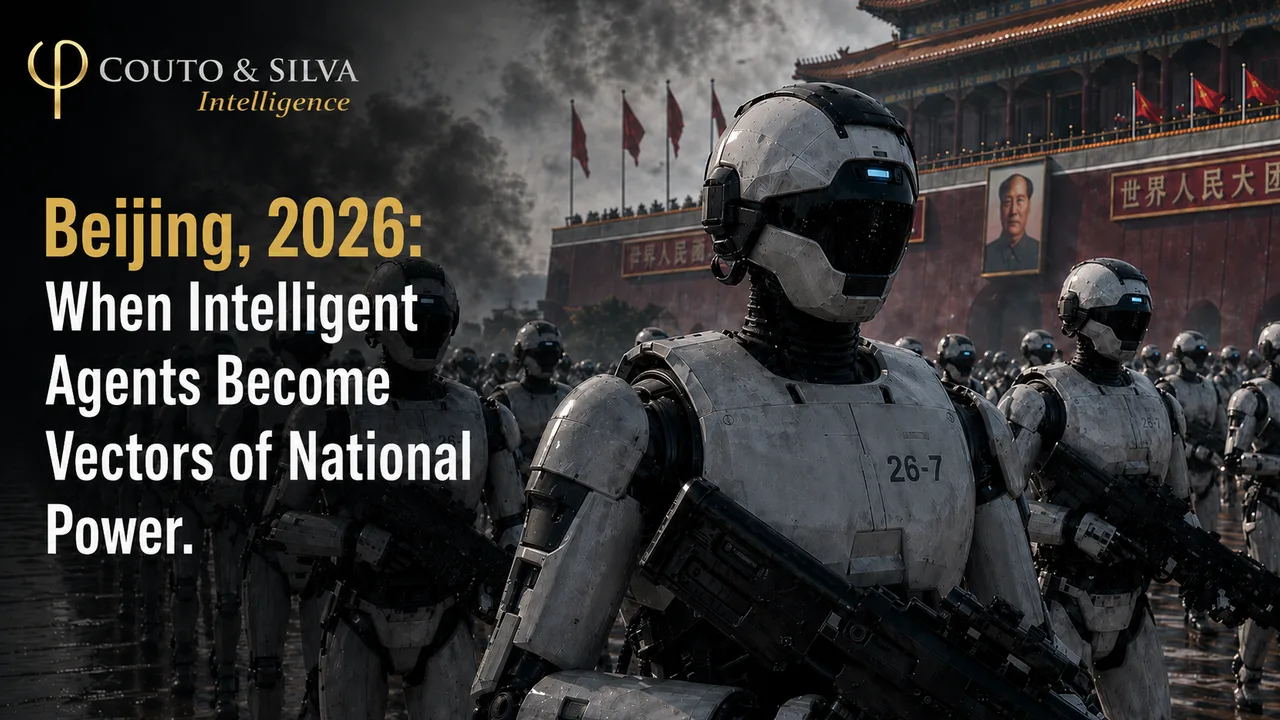
In April 2025, the winner of Beijing's first Humanoid Half-Marathon finished in 2 hours and 40 minutes — remotely controlled, with only 6 of the 21 participants reaching the finish line. On April 19, 2026, the robot "Lightning," manufactured by China's Honor, completed the same course autonomously in 50:26 — surpassing the human world record of 57:20, held by Uganda's Jacob Kiplimo. (Reuters, April 19, 2026)
In 12 months: 70% reduction in completion time. From 21 teams to over 100. From 6 finishing robots to 47.This is not linear evolution. It is the deliberate acceleration of capability.
What the IDIs Reveal
Within the MIEG-SIA ecosystem, COUTO & SILVA INTELLIGENCE employs two proprietary sensors to decode this signal: the Technological Advantage Index (TAI) and the Scientific/Technological Cooperation Index (STCI).
The TAI measures technical readiness under real-world conditions — embedded autonomy, systemic resilience, and compression of development cycles. The leap is quantifiable: 38% of teams operating autonomously in 2026, versus zero in 2025. None of these outcomes occur by accident. According to Reuters, the Chinese government allocated over $20 billion in subsidies to the robotics sector between the second half of 2024 and early 2025. More than 150 humanoid robotics companies now operate in China, which accounts for approximately 80% of globally deployed humanoid units. (Reuters / ChinaPower-CSIS, 2026)
The STCI reveals the strategic design that converts technical capacity into National Power. And herein lies the thesis that the Beijing spectacle merely makes traceable.
The Hidden Architecture: The Revisionist Axis
China does not develop technology in isolation. It operates at the center of a cooperation architecture among actors sharing a structural objective: to redesign the international order without Western hegemony.
"China has collaborated with Russia, Iran, and North Korea to develop capabilities that complicate U.S. operations abroad." — CSIS, 2025
CSIS documents: China, Russia, Iran, and North Korea — the so-called "CRINK" axis — actively cooperate in developing military, intelligence, and dual-use capabilities.
The data are unequivocal. According to the Atlantic Council, China already supplies approximately 80% of the critical technologies used in Russian drones, with engineers from both nations collaborating directly on development and battlefield operational adaptation. (Atlantic Council, March 2026)
The CSIS Korea Chair documents that North Korean workers have been deployed to Russia to operate drone factories combining Iranian technologies with Chinese equipment — and that the number of joint military exercises among axis countries jumped from an average of 3.2 per year to 9.5 per year between 2022 and August 2025. (CSIS, 2025)
Russia and China have transitioned from diplomatic allies to technological anchors for Iran — providing advanced air defense systems, Su-35 fighter jets, and satellite navigation to neutralize Western stealth and jamming capabilities. In February 2026, amid U.S. force buildup in the Middle East, China deployed vessels to the region capable of tracking the U.S. fleet and providing positioning data for Iranian operations. (Special Eurasia / JINSA, March 2026)
The U.S. Intelligence Community's Annual Threat Assessment (DNI, March 2026) is direct: China, Russia, Iran, and North Korea will continue seeking to compromise U.S. government and private networks — and innovation in Artificial Intelligence will accelerate these threats in the cyber domain.
This is not accidental cooperation. It is integrated power projection — and autonomous robotics is the next vector of this architecture.
What Financial Markets and States Have Not Yet Recognized
When the TAI signals accelerated technical maturity — with autonomous robotics moving from laboratories to 21-kilometer courses under real-world conditions — capital must reposition exposure across industrial chains vulnerable to disruption by state-coordinated Chinese technological advancement.
When the STCI reveals systemic cooperation among revisionist actors with a shared strategic purpose, concrete risks emerge for assets exposed to: secondary sanctions, rupture of international technological standards, and asymmetric disruption of critical supply chains.
China already leads the formulation of IEC standards for robotics and is exporting its domestic standard as a de facto norm — the same maneuver successfully executed with 5G and high-speed rail. (The Diplomat, March 2026)
The Western model prioritizes incremental control and compliance. The Revisionist Axis operates systemic coordination with strategic purpose. In the ontology of National Power, coordinated ecosystems outpace isolated projects.
The Question That Matters
Contemporary warfare does not begin on the battlefield. It begins in the capacity to innovate, scale, and integrate science, technology, and production with geopolitical expansion.
The robot that ran in Beijing on April 19 is not a technological curiosity. It is the signal that the gap between civilian capability and autonomous military application is closing — deliberately, systematically, and with state funding unparalleled in the Western world.
The TAI and STCI do not predict the future. They reveal who is designing the board — and with which pieces.
The question for public and private decision-makers is not "What will happen?"
It is: By which index are we measuring our own capacity to anticipate a power architecture already in motion?
Grand Strategy is the conscious direction of all factors that strengthen a nation. Today, those factors include autonomous agents scaling at a vertiginous pace. Those who do not master them will certainly be mastered by them.