I. The State at the Climax of Centralization
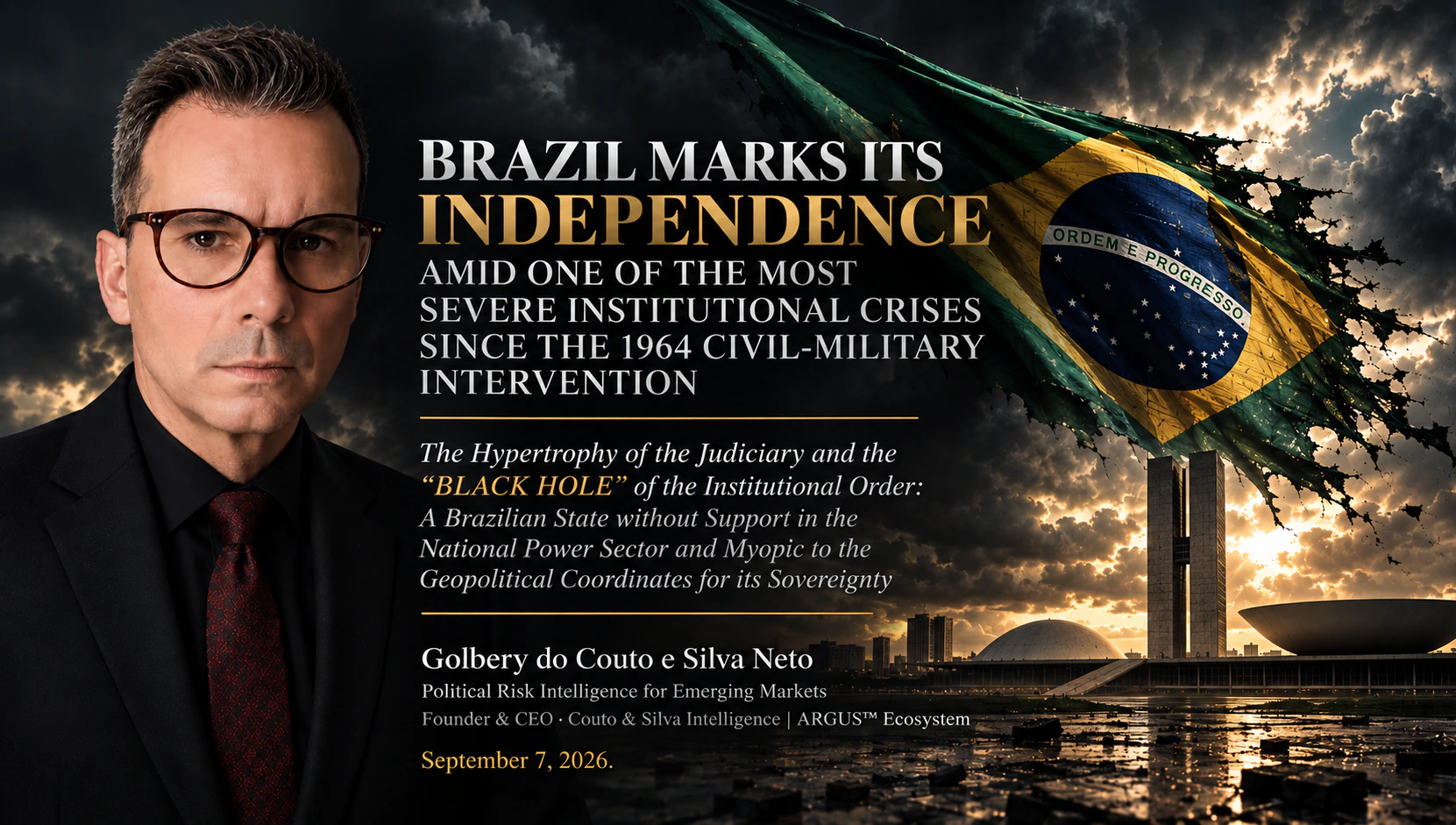
On this 7 September 2026, Brazil marks its Independence amid one of the gravest institutional crises since the civic-military intervention of 1964. The date fulfils the calendar. What it does not find is a nation in any condition to celebrate it: the institutions charged with limiting, investigating and judging power have begun to dispute among themselves the legitimacy of their own acts.
A 218-page report by the Federal Police, unsealed by decision of Justice André Mendonça of the Federal Supreme Court (STF), assembled messages, records of meetings and other material extracted from the mobile phone of former banker Daniel Vorcaro involving Justice Alexandre de Moraes, also of the STF. The Federal Police itself noted that, as of that moment, it had carried out no further investigative steps directed at Moraes or at any other member of the Court. [1]
What followed sets out the anatomy of the conjuncture. Moraes asked the President of the Federal Supreme Court, Edson Fachin, to take steps to examine Mendonça’s conduct, citing indications of offences extending beyond the unsealing itself. [2] The Prosecutor-General of the Republic, Paulo Gonet, moved to annul part of the inquiry. [3] In the Senate, Senator Carlos Viana filed an impeachment request and threatened to seek the removal of the chamber’s President, Davi Alcolumbre, should the proceedings not be tabled. [4] [5] And the Office of the Prosecutor-General opened an examination of the conduct of the Federal Police itself in producing the report. [6]
These events do not authorize anyone to presume criminal guilt, nor to convert indications into a conviction. They do, however, demonstrate an exceptional collision among the very bodies meant to hold one another in check. The problem exceeds the police case: the controversy over who may investigate, annul, judge or block an inquiry has moved to the centre of the institutional system itself. When litigation over competence replaces the exercise of competence, the State stops deciding about the country and begins deliberating about its own operators.
This is not a passing episode of governability, nor one more political scandal of national scale. It is the empirical manifestation of a phenomenon that an analysis in political sociology described decades ago, and which the present conjuncture now reproduces with almost didactic fidelity: the formation of an institutional Black Hole at the centre of National Power.
II. How Concentration Is Born of Paralysis
The life of the Brazilian State is constituted by a dialectical principle that precedes any particular conjuncture. Centralization and decentralization are not sealed phases succeeding one another on a calendar, but the obverse and reverse of a single process, both present at every moment. The advance of one brings about the emergence of the intrinsic factors of the other, which is thus born of the first, gestated in its womb, fed by it, and grows until it finally inverts the terms of the permanent equation of equilibrium in which the coexistence of the two, in their immanent opposition, is expressed. Neither wins definitively. They alternate. What changes from one cycle to the next is who conducts the inversion — and at what cost.
There is one trait in this dynamic that ordinarily escapes conventional readings, and it is decisive for understanding 2026. Centralization is not born of strength. It is born of inoperancy. The march toward maximum concentration proceeds from a maximum of paralysis: when the bodies charged with deciding stop deciding, competence does not disappear — it migrates. It accumulates wherever there is a willingness to exercise it. The nucleus of power that emerges from this process conquered nothing; it occupied the vacuum the others left behind.
Taken to its limit, this process changes in nature. There is a threshold beyond which the concentration of power ceases to be an instrument of government and begins to behave as a physical phenomenon. The State, at that point, resembles a star that has exhausted its nuclear fuel: the concentrated mass generates a field of attraction against which the remaining organs cannot hold a trajectory of their own, and out of which not even light — information, accountability, the adversarial process — escapes. The comparison with the black holes of astronomy is neither my invention nor an analytical novelty: it belongs to the tradition of sociological thought recorded in the bibliography of this essay, and it was employed there with the irony the figure deserves. I resort to it because it describes, with uncomfortable precision, what can be observed today.
The Legislature reacts, but lacks the strength to impose itself as a counterweight. The Office of the Prosecutor-General disputes the validity of the inquiry rather than conducting it. The Supreme Court deliberates on the conduct of its own justices. And the information that reaches the public arrives fragmented by seals, leaks, single-justice rulings and conflicting accounts. The process advances without anyone having decided it, because each step appears justified by the one before — and it is this unconscious character, rather than bad faith on anyone’s part, that makes the concentration so difficult to interrupt.
This is the terminal phase of the Systole: the moment when concentration, born to supply the inoperancy of others, becomes an end in itself and begins to operate in the service of its own preservation. And it is precisely there that the dialectical movement begins to generate, in its own womb, the seeds of the Diastole to come. The forces that brake concentration do not come from outside the system. They are produced by it, out of the saturation it created itself.
What the case files reveal — private meetings, arrangements around events in London, messages in which a man under investigation sought to anticipate the risk of an operation — does not, on its own, prove capture of the Judiciary. It reveals something institutionally grave and disquieting: private interests reached the apex of the State, and are now being examined by authorities who are themselves disputing competence, legality and control of the proceedings. [1]
III. Cultural Lag and the Hypertrophy of the Political Sector
National Power manifests itself in five interlinked expressions, each with its own rhythm: political, economic, psychosocial, military and scientific-technological. The dynamic of Systoles and Diastoles operates on all of them simultaneously, but does not propagate through all at the same speed.
One field may advance while the others remain stagnant, or may move against the general current — this is what sociology, since Ogburn, calls cultural lag. If the discrepancy exceeds a certain limit, a potential for rupture or displacement of the system emerges: the lag begins to brake the entire process, unless new impulses reduce the distance between the fields. Recognizing the discrepancy before it turns into collapse is, historically, the first duty of a statesman.
In 2026, the lag manifests itself once again in the political sector, in an unprecedented form: not the hypertrophy of the Executive, as in the previous cycle (1964), but that of the Federal Judiciary and of its capacity to condition the action of the other two branches.
Applied to the present conjuncture, the observation about the origin of centralization dissolves a common misunderstanding. The Federal Judiciary did not seize the competences of others by force. It absorbed them by gravity, as the Legislature ceased — or was prevented — from deciding on matters within its remit, and the Executive came to prefer the judicial route to political negotiation. A hypertrophy built this way is harder to reverse than a usurpation, because there is no act of force to undo: there is an institutional habit to replace. And replacing it requires that the hollowed-out bodies resume exercising what they abandoned — something no judicial decision can determine in their stead.
The Supreme Court has ceased to appear merely as arbiter and has become a direct protagonist in political conflicts. This does not eliminate the Court’s constitutional function, nor does it cause the State to lose its monopoly of jurisdiction, which is a legal attribute and not a reputational one. What erodes is something else, and harder to restore: the cohesion and authority required for its decisions to be recognized as an impersonal expression of the legal order, rather than as moves in a dispute between parties. A court whose decisions come to be read as personal tactical manoeuvres loses not its competence, but the symbolic efficacy that makes competence sustainable.
IV. Geopolitical Myopia: The Internal Black Hole and External Sovereignty
The lag in the political sector does not remain confined to domestic life. It reduces the State’s capacity to set priorities, coordinate resources and negotiate the country’s international position. Sovereignty is not limited to legal title over territory or mineral deposits: it demands the capacity to organize productive chains, retain critical technologies and convert natural resources into bargaining power.
The Serra Verde case exposes that difference with uncomfortable precision. The company responsible for Brazil’s only large-scale commercial extraction of rare earths was the object of a definitive acquisition agreement by the American firm USA Rare Earth, announced in April 2026 and valued at approximately US$2.8 billion. The arrangement includes the supply, over fifteen years and with guaranteed minimum prices, of 100% of Phase I production to a special-purpose vehicle capitalized by agencies of the United States government and by private investors. The DFC, the U.S. government’s development finance agency, provided a package of US$565 million. And the United States Department of Commerce is to receive 16.1 million common shares and some 17.6 million warrants in the resulting company. On 11 May 2026, CADE, Brazil’s antitrust authority, opened proceedings to determine whether the combination and the supply agreement constitute a concentration requiring mandatory notification. [7] [8] [9]
It is worth stating what this is not. Brazil has not lost legal title to its reserves; the deposit remains on national territory, under Brazilian mining law, and the transaction remains subject to regulatory approval. What has changed is of another order, and it is precisely the order that matters for National Power: the financing, the destination of production and part of the industrial integration have come to be organized by a foreign strategy of supply security — and a foreign State has become a shareholder in the chain that begins at the Brazilian mine.
The study supported by the Ministry of Mines and Energy records that the operation positions the Brazilian mine as the initial base of a mine-to-magnet chain whose higher value-added stages — separation, metallization and magnet fabrication — are distributed across the United States, the United Kingdom and France. Without a policy capable of retaining processing, technology and advanced manufacturing, Brazil settles into the position of raw-material supplier to a chain decided abroad. It is here, through the loss of the capacity to decide where value is formed, that the arrangement weakens Brazilian National Power. Sovereignty, in this register, is not title to the deposit: it is the capacity to determine what is done with it. [10]
The Amazon presents the same equation in another register. A study by the Brazilian Intelligence Agency (ABIN) describes the articulation of Brazilian criminal organizations — the Comando Vermelho and the Primeiro Comando da Capital — with Colombian groups for the purchase and transport of drugs across the shared Amazon. In August, indigenous communities of the Alto Rio Negro, in São Gabriel da Cachoeira, reported the presence of armed men arriving from Colombia; the Federal Public Prosecutor’s Office opened a civil inquiry and summoned the Army, the Navy, the Air Force and the Federal Police to report the measures taken. [11] [12]
It would be false to conclude from this that the State is absent. In that same month, the Federal Police launched a joint operation with Peruvian forces that destroyed fifteen laboratories and four clandestine airstrips and seized roughly twelve tonnes of cocaine sulphate. [13] The figure that qualifies this presence is a different one, and it is structural: the border with Colombia runs 1,644 kilometres and is garrisoned by Special Border Platoons whose strength ranges between 35 and 50 soldiers, in an Amazon where 28 platoons cannot be reached by road. [12] The presence exists, and that must be acknowledged. It is, however, discontinuous, logistically expensive and dependent on extraordinary operations to confront structures that operate permanently. The difference between operating and being present is exactly the difference between reacting and deterring.
The relationship between the two cases is strategic, not thematic. While the State consumes its energy in disputes over its own competence, foreign capital organizes critical-mineral chains and criminal networks exploit the voids of coordination along the borders. The great powers negotiate from national objectives that are defined and stable, and that survive changes of government. Brazil arrives at the table with resources, but without the equivalent capacity to articulate its political, economic, military and scientific-technological expressions. It possesses potential; it converts little of that potential into power. And unconverted potential is not a strategic reserve: it is an asset that someone else converts, or simply takes.
V. The Absence of a Directing Elite
Brazilian social formation produced, according to the conservative tradition of thought, a society of ganglionic structure: regional nuclei and particular interests with little capacity to formulate a common national direction. Central power would arise as the force catalysing unity — but, within that same tradition, it would hold historical legitimacy only if it organized that force in the service of the National Objectives, and not of its own perpetuation.
This is what distinguishes a directing elite from a dominant group. Wealth, office and prestige allow one to dominate; they are not enough to direct. A genuine directing elite transforms particular interests into a conception of the national interest, reads the conjuncture before it imposes decisions, negotiates conflicts without destroying institutions, and prepares the State for threats that outlast any single government’s mandate. The dominant group does the inverse: it converts the national interest into an instrument of particular disputes, and treats institutions as positions to be occupied.
The Federal Police report does not, on its own, prove the non-existence of such an elite. It documents its fragmentation. Authorities charged with investigating, prosecuting and judging have begun to debate publicly the limits and the legitimacy of their own actions, while decisions on critical minerals and on border security advance without any equivalent national direction. The Brazilian State possesses powerful institutions. What cannot be identified, thus far, is the nucleus capable of coordinating them around National Power and around the country’s genuine interests.
VI. The Delayed Diastole and the Absent Statesman
Two phenomena operate simultaneously in the life of States, and confusing them is the gravest error an analyst of the conjuncture can commit.
The first is the natural dialectic of the system. Every centralization, as it approaches its climax, generates in its own womb the forces that will come to brake it. No one needs to summon them; they are born of saturation, of inefficiency, and of the resistances accumulated by the concentrating movement itself. It is worth resisting the determinist temptation, however: the processes of centralization and decentralization have neither defined beginnings nor defined ends, and their maxima occur within a broad and diffuse band. The Diastole is not a clock. It is a pressure — and pressure can be contained, diverted or postponed for a long time.
The second is the conscious action of the statesman, or of a cohesive and responsible political group. In the mid-1970s, once the maximum of political-administrative centralization had been reached, the deliberate efforts of the federal government were added to the braking tensions that had already arisen naturally within the system itself. The Diastole was not invented by that government: it was recognized, coordinated and conducted before accumulated pressure could produce an uncontrollable rupture. That is the difference between a transition and a flood, and it lies not in the force of the movement but in the presence of someone who perceives it in time.
In 2026, the seeds of the Diastole are alive, and they are not confined to the Judiciary. The political expression of National Power is saturated across its entire extension.
In the psychosocial expression, the reaction is the sharpest and the most precisely datable. On 1 and 2 September, the editorials of O Estado de S. Paulo, Folha de S.Paulo and O Globo converged, respectively, on advocating the immediate departure of Justice Alexandre de Moraes, on calling for his resignation with impeachment as the alternative, and on demanding that the President of the Court urgently convene the full bench. [14] This is not scattered opinion: it is the core of the reference press operating in the same direction, which in any reading of the conjuncture constitutes a braking force of the first order.
In the Legislature, the impeachment requests and the threat to remove the President of the Senate show a chamber under pressure to react, yet still incapable of setting the course of the crisis. [4] [5]
In the Executive, three inquiries are examining conduct attributed to Fábio Luís Lula da Silva, among them suspicions of influence peddling and possible irregularities in public contracts. His defence denies any participation in illegality, and the opening of an inquiry is equivalent neither to an accusation nor to a conviction. The politically relevant fact is not guilt, which has not been established, but timing: the investigations reach the President’s family circle in the middle of an electoral contest, amplifying the pressure on governmental legitimacy. [15]
In the economy, the picture demands the same precision. In its June Monetary Policy Report, the Central Bank recorded accelerating activity and a heated labour market, but pointed to widespread inflation, expectations above target and a high degree of uncertainty. Economic collapse is not a fantasy; specialists have already announced it. What matters is to recognize that persistent inflation, high interest rates and doubt about the sustainability of growth feed psychosocial tension and narrow the State’s room for manoeuvre — including the fiscal and political room required to conduct any orderly transition out of institutional crisis. [16]
And within the control apparatus itself, the recursion: the Office of the Prosecutor-General is examining the conduct of the Federal Police that produced the report on the justice who requested the investigation of the justice who unsealed it. [6] When the mechanism of control begins to control the mechanism of control, the institutional purpose has ceased to be applied to the country.
Taken together, these facts do not amount to a structural collapse, and it would be imprudent to describe them as such. They amount to braking tensions accumulating without a common direction — which is a different state, and in certain respects a more dangerous one, because it produces neither stability nor resolution.
The question, therefore, is not whether the Diastole exists. It is already at work inside the saturated structure. The question is not whether. The question is who: who will prove capable of recognizing it and of articulating the expressions of National Power so that decentralization does not occur through anomie or social convulsion. In 1974, there was a political nucleus willing to conduct the movement of decentralization. In 2026, no statesman or directing group can be identified with the authority, the project and the instruments to change the catastrophic direction in which the Brazilian State is heading.
And there is a final asymmetry worth not forgetting. Concentration made itself, by gravity, taking advantage of the vacuum of power left by those who ought to have established themselves responsibly. Decentralization will not make itself the same way: it demands decision, coordination, and someone willing to bear the political cost of returning competences that are today fundamental to restoring a more democratic dynamic. That is why the Systole advances without a guide while the seeds of the Diastole go on being dammed.
Without that awareness and that direction, the Diastole turns dangerously capricious: it is delayed, it fragments, and it accumulates pressure. When it finally breaks the mechanisms containing it, it may not take the form of a coordinated, gradual and safe transition. A decentralization without a conductor does not produce a symphony. It produces deafening noise — and noise, in the life of democratic States, is the sonic form most indicative of the disintegration of order and progress. Either Brazil normalizes of its own accord, or we shall have the other road. A still more violent Systole. A centralization far deeper than the one we are watching in astonishment. But we must never forget the dialectical process. In the absence of a statesman to conduct the dynamic responsibly, the synthesis will come regardless — we do not know when, nor by what route — and it may take the form of external intervention, with a lasting stain on Brazilian national sovereignty. In the streets, that noise is already growing. Within the present Government, the hypothesis has come to be treated as a reality warranting alarm and fear.
Golbery do Couto e Silva Neto
International relations specialist, Master in Political Sociology, and CEO of Couto & Silva Intelligence. Researcher in geopolitics and National Power in the twenty-first century.
Sources on Recent Events
- CNN Brasil. Divulgação de mensagens de Vorcaro a Moraes aprofunda crise no STF. 2 Sept. 2026.
- Agência Brasil. Moraes encaminha a Fachin pedido de investigação contra Mendonça. 3 Sept. 2026.
- Agência Brasil. PGR pede anulação de investigação sobre conversas de Moraes e Vorcaro. 1 Sept. 2026.
- Agência Senado. Viana apresenta pedido de impeachment contra Alexandre de Moraes, do STF. 1 Sept. 2026.
- CNN Brasil. Impeachment? Para aliados, Alcolumbre vai deixar caso Moraes com o STF. 2 Sept. 2026.
- Consultor Jurídico. PGR apura atuação da PF em relatório sobre Alexandre e Vorcaro. 5 Sept. 2026.
- Serra Verde. Acordo de combinação com a USA Rare Earth e acordo de fornecimento de 15 anos com preços mínimos garantidos. 2026.
- USA Rare Earth. Announces Definitive Agreement to Acquire Serra Verde Group for ~$2.8 Billion. 20 Apr. 2026.
- CADE (Brazilian antitrust authority). Cade apura acordos de combinação e de fornecimento em terras raras. 11 May 2026.
- Ministry of Mines and Energy and CEBRI. Relatório final: apoio à preparação da Estratégia Nacional de Terras Raras. 2026.
- Brazilian Intelligence Agency (ABIN), via CNN Brasil. Abin aponta aliança de PCC e CV com grupos colombianos no tráfico de drogas. 2026.
- Revista Sociedade Militar. Alto Rio Negro: pelotões especiais, os 1.644 km de fronteira com a Colômbia e o inquérito do MPF. Aug. 2026.
- Federal Police. PF realiza operação integrada na fronteira entre Brasil e Peru. 31 Aug. 2026.
- CNN Brasil. Editoriais de Estadão, Folha e Globo pedem saída de Moraes do STF. 3 Sept. 2026.
- Agência Brasil. Flávio Dino autoriza novo inquérito da PF para investigar Lulinha. 4 Aug. 2026.
- Central Bank of Brazil. Relatório de Política Monetária (Monetary Policy Report). 25 June 2026.
Theoretical References
COUTO E SILVA, Golbery do. Conjuntura Política Nacional: o Poder Executivo & Geopolítica do Brasil. 2nd ed. Rio de Janeiro: José Olympio, 1981.
COUTO E SILVA NETO, Golbery do. Sístoles e Diástoles na Vida dos Estados: o pensamento de Golbery do Couto e Silva. Master’s dissertation. Rio de Janeiro: Universidade Candido Mendes and IUPERJ, 2019.
OGBURN, William F. Social Change with Respect to Culture and Original Nature. New York: B. W. Huebsch, 1922.
VIANNA, Oliveira. Evolução do Povo Brasileiro. 3rd ed. São Paulo: Companhia Editora Nacional, 1938.